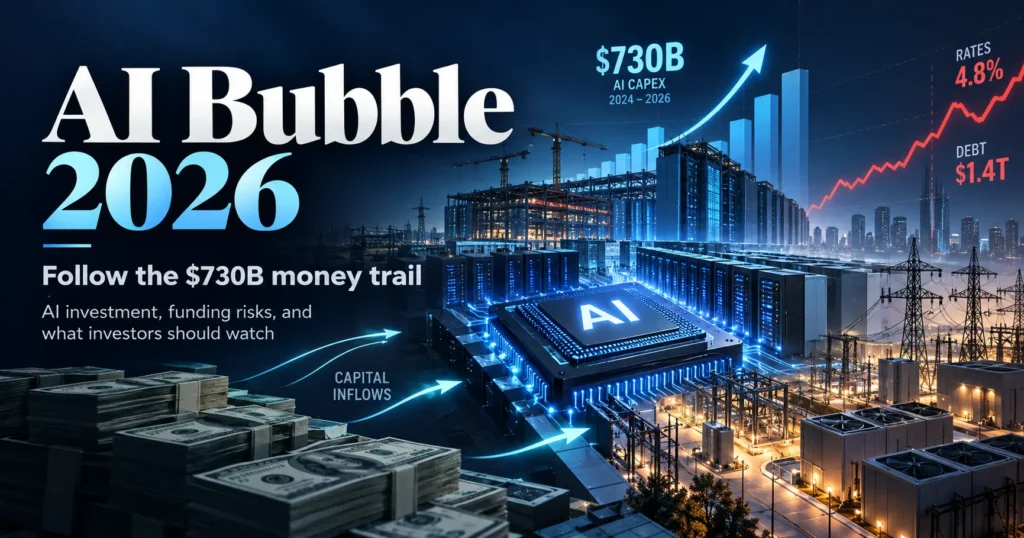
There is a real demand for AI. So is the money. The more relevant question for investors is whether revenue can convert to cash fast enough to keep the capital machine running when money is more expensive.
To many investors, the question of whether artificial intelligence is a “bubble” has become too crude to be helpful. It can be a revolutionary technology and still deliver disappointing results for investors if the capital comes in too soon, and at too high a cost. Railroads changed economies. Communications were transformed by fiber optic networks. The Internet changed all that. In both cases, a few investors still lost fortunes because the financing cycle cracked before the technology story did. Social media investing can also drive short term market excitement, impacting retail investor sentiment and volatility around hot themes.
So a more useful way to look at it is to monitor the funding gap. Where companies still require vast sums of external capital but investors and lenders are unwilling to supply it on acceptable terms. Jonathan Weil recently resurrected this boom bust idea for AI. It may be capital, not technological merit, that provides the pressure point to end a mania1.
The short version
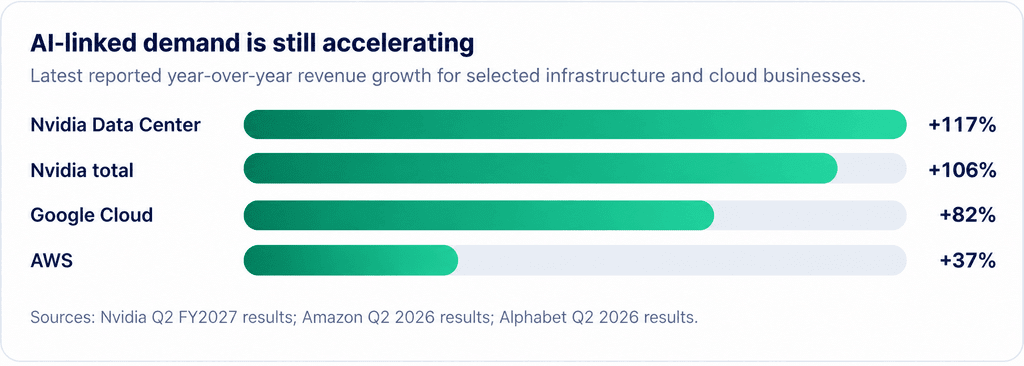
- Demand is not imaginary: Nvidia’s latest quarterly revenue rose 106% year over year; AWS grew 37%. Google Cloud grew 82%.
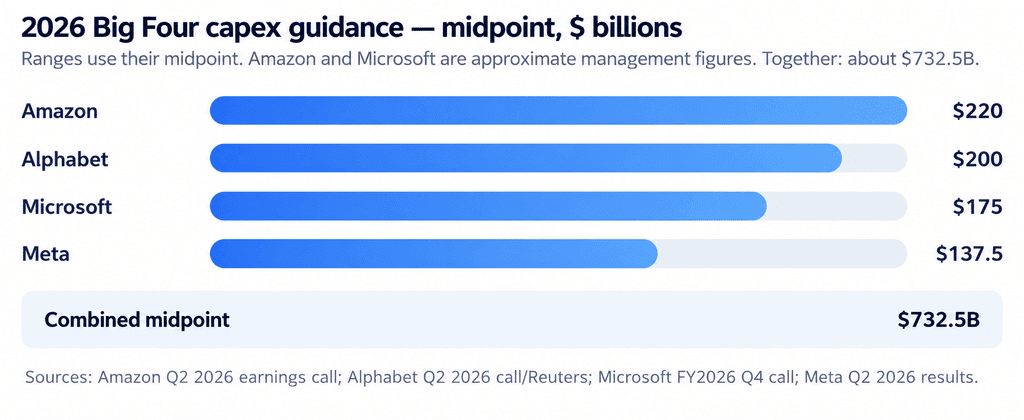
- The spending is extraordinary: current 2026 guidance from Amazon, Alphabet, Microsoft and Meta implies roughly $720–745 billion of capital expenditure, with a midpoint near $733 billion.
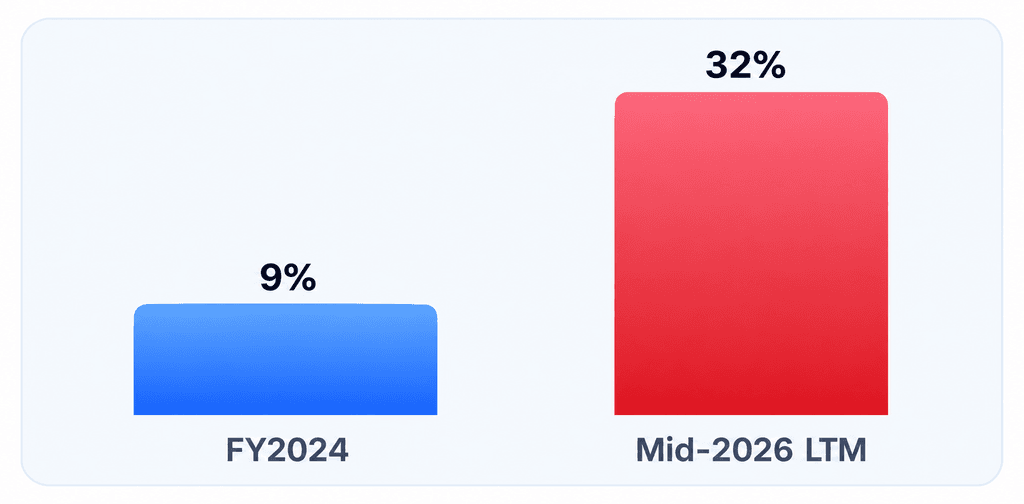
- The funding mix is changing: FactSet estimates incremental annual debt rose from about 9% of capex in FY2024 to 32% on a trailing basis by mid-2026.
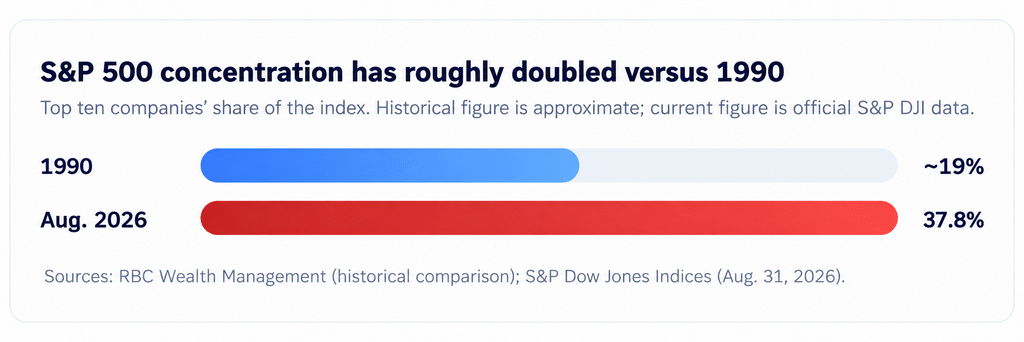
- For ordinary investors: the risk is not only owning an AI stock. The S&P 500’s ten largest constituents already represent 37.8% of the index.
-733B
Midpoint of 2026 capex guidance for Amazon, Alphabet, Microsoft and Meta.
32%
Incremental debt as a share of capex by mid-2026, versus 9% in FY2024.
37.8%
Weight of the ten largest S&P 500 constituents as of Aug. 31, 2026.
The idea that matters: AI can be real and still be over financed
Investors tend to split the AI story into two camps: “AI changes everything” or “AI is a bubble.” Both can be partly correct. The technology could deliver huge productivity gains as the market overpays for some of the infrastructure and companies needed to build it simultaneously.
A funding gap is the difference between the cash a business can generate on its own and the cash it still requires from outside investors or lenders. The gap turns dangerous when that outside money either goes away or gets so expensive that the economics of the project don’t work.
The AI capital flywheel — and where it can break
A simplified model for thinking about the boom. The technology can keep improving even if the financing loop weakens.
1. Raise cash
profits, debt, equity
2. Build capacity
chips, data centers, power
3. Sell AI services
profits, debt, equity
4. Grow revenue
usage and pricing
5. Convert to cash
chips, data centers, power
Break point
If cash lags spending and new capital becomes costly
The central question is no longer “Is there demand for AI?” There clearly is. The question is whether the cash return on that demand can catch up with the cost of building the infrastructure.
The bill: roughly $730 billion from four companies in one year
The scale by company is easier to understand. Amazon now expects around $220 billion in cash capex in 2026. Alphabet raised its guidance to $195-205 billion. Microsoft said its calendar-2026 capex view is around $175 billion after a lease accounting shift. Meta cut its outlook from $130 billion to $145 billion2.
Big capex is not always a bad thing. Shareholders want companies to spend if they can invest $1 today and get many times that in future cash flows. The problem is the buildout is taking place faster than cash is being generated, which is forcing companies to lean more on the capital markets.
Alphabet provides a useful snapshot. In Q2 2026, it generated $39.1 billion in operating cash flow but paid $44.9 billion toward property and equipment, leading to a quarterly free cash flow of around negative $5.9 billion. In June, Alphabet also raised $49.6 billion of net equity proceeds and set up an up-to-$40 billion at-the-market program. It had not sold shares through that ATM program as of June 303. That’s a more complete picture than simply saying the company “raised $85 billion.”
The bull case is stronger than bubble headlines suggest
The evidence required is unusually strong. Nvidia reported quarterly revenue of $96.2 billion, up 106% year-over-year, including $89.0 billion from Data Center, up 117%. AWS grew 37% to $42.2 billion for the quarter, its fastest growth in 18 quarters. Google Cloud rose 82% to $24.8 billion456.
This is why something as simple as a comparison to Pets.com or other loss making dot com companies misses something important. Today’s leading AI infrastructure vendors are shipping a lot of real product to real customers. A lot of them are very profitable. The risk is not “no money”. It’s capital intensity. The risk that every additional dollar of AI revenue requires too many dollars of infrastructure for too long.
The picture is complicated by private AI labs. Reuters reported that Anthropic’s annualized revenue run rate was more than $65 billion as of the end of July, up from about $9 billion as of the end of 20257. Meanwhile, sources say that the company is in talks for another round at a valuation of around $1.2 trillion8. Those numbers mean there is still capital at the top of the market.
But treat private company forecasts differently than audited public company filings. An investor presentation estimated OpenAI’s cumulative negative free cash flow at about $278 billion from 2026 to 2030, according to the Financial Times. OpenAI declined to comment, but The Information reported that an OpenAI finance executive publicly said the figures were wrong910. Investors should not accept or reject the number blind; they should recognize how uncertain the cash economics of frontier-model companies still are.
The hidden regime change: more of the build is being financed
The biggest difference between the two analyzes given, and one that checks out when fact-checked, is that the AI buildout relies more and more on external finance. FactSet estimates incremental annual debt at major hyperscalers climbed from about 9% of capital expenditures in fiscal 2024 to 32% on a trailing basis in mid-202611.
Debt is becoming a larger part of the AI build
Incremental annual debt as a share of hyperscaler capex, FactSet estimate.
Why it matters
Debt adds a clock. Equity can absorb a long wait for returns debt has coupons, maturities and refinancing risk. That does not mean the hyperscalers are distressed many still have excellent balance sheets but the marginal project is becoming more sensitive to rates and credit conditions.
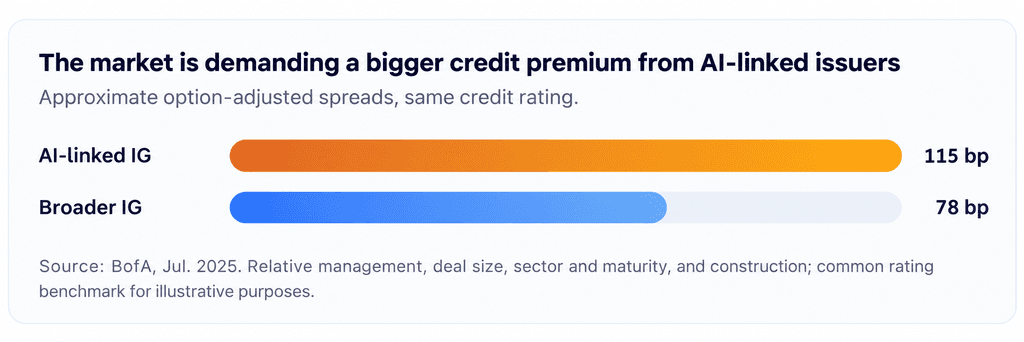
The bond market is starting to price in that uncertainty. AI-related investment-grade bonds traded close to 115 basis points over benchmarks, versus around 78 basis points for the broader market, Reuters said. Goldman Sachs data seen by Reuters shows hyperscaler gross debt issuance is expected to reach $420 billion in 2027, a rise of about 60% from 2026 estimates12.
Rates turn “great technology” into a harder investment equation
The 10-year U.S. Treasury yield ended Sept. 25 at 5.17%13. And that matters, because the Treasury yield is a building block for the price of money across the economy. When the risk free alternative pays more investors demand more compensation from stocks, corporate bonds and long duration projects. If you want a deeper look at the transmission mechanism, see our guide to how Fed rate hikes impact stocks and bonds.
For example, the 6.7% Oracle bond maturing in 2056 was trading at a yield to maturity of around 8.07% on Sept. 2414. Again, this does not automatically imply a default. It does show how much more expensive long-lived AI infrastructure can get as financing conditions tighten. Treasury markets also can respond to broader fiscal uncertainty and policy disruptions, which is why it can be useful to know the economic effects of a government shutdown when assessing rate-sensitive investments.
Beginner translation
If a data center is expected to earn 8% but borrowing money costs close to 8%, the project has little room for mistakes. If funding costs fall or the project earns 15%, the economics look very different. That is why interest rates can change valuations even when customer demand is still strong.
You may own more AI risk than you think
Many investors believe an S&P 500 fund means their money is evenly distributed among 500 companies. It isn’t. The index is market cap weighted, meaning that the largest companies will have the largest weights. As of Aug. 31, 2026, the top ten constituents comprised 37.8% of the S&P 50015.
Concentration is not a selling signal. Market leadership can be maintained for years. But that alters the meaning of “diversified. If you own an S&P 500 ETF, an ETF tracking the Nasdaq-100, a technology fund, and individual shares of Nvidia, Microsoft, or Amazon, the same companies can show up in multiple places at once.
A simple overlap audit
| What to check | Why it matters | Action |
| Top 10 holdings of every ETF | Different fund names can hide the same megacap exposure. | Add repeated holdings across funds. |
| Technology + communication services weights | AI beneficiaries span several sectors, not just “technology.” | Look at total economic exposure, not labels. |
| Individual stocks already inside your ETFs | Direct positions can double an exposure you already own indirectly. | Count both direct and fund exposure. |
| Money needed within a few years | Short horizons and volatile assets are a poor match. | Separate near-term cash needs from long-term risk capital. |
The investor dashboard: six signals that matter more than headlines
Instead of trying to predict the exact top of the AI cycle, monitor the conditions that keep the capital flywheel alive. The indicators below are descriptive, not a forecast.
Strong
End demand
Nvidia, AWS and Google Cloud are still posting very high growth.
Watch
Free cash flow
Capex is consuming more operating cash. Alphabet posted negative quarterly FCF in Q2.
Watch
Funding mix
FactSet’s debt-share estimate rose from 9% to 32%.
Tight
Cost of capital
The 10-year Treasury is around 5.17% and AI-linked credit spreads are wider.
Open
Private capital
OpenAI is reported to be discussing a new round at roughly a $1.2T valuation.
High
Index concentration
The S&P 500 top ten account for 37.8% of the index.
Concentration is not a selling signal. Market leadership can be maintained for years. But that alters the meaning of “diversified. If you own an S&P 500 ETF, an ETF tracking the Nasdaq-100, a technology fund, and individual shares of Nvidia, Microsoft, or Amazon, the same companies can show up in multiple places at once.
Three scenarios to think through — without pretending to know which comes next
| Scenario | What it looks like | What investors would watch |
| Monetization catches up | AI revenue remains strong while capex growth slows. Free cash flow rebuilds. | Cloud margins, utilization, enterprise AI spending, lower funding needs. |
| Higher-for-longer digestion | Demand remains healthy, but 5%+ long rates and heavier borrowing compress valuations and cash returns. | Credit spreads, depreciation expense, capex revisions, valuation multiples. |
| True funding gap | Major private rounds or infrastructure financings struggle to clear except at sharply worse terms, causing project delays. | Failed or downsized raises, delayed data centers, tighter lender covenants, simultaneous supplier weakness. |
Note that none of these scenarios require AI to “fail. Even with growing use, the funding-gap scenario can occur. The difference is whether the financial structure can withstand the mismatch of timing between spending today and generating cash tomorrow.
What a beginner-to-intermediate investor can actually do
The practical response is not to make an all-or-nothing call on AI. It is to make sure your portfolio does not require one forecast to be right.
A 10-minute portfolio stress test
- Identify repeated AI exposure. Check whether the same megacaps appear in multiple ETFs plus your individual stock holdings.
- Separate investing money from near term money. Emergency savings, tuition, house deposits and other short-horizon needs should not depend on a volatile theme staying expensive. If higher living or borrowing costs are squeezing your cash flow, it can also help to revisit how to budget money before increasing market risk.
- Distinguish profitable platforms from capital dependent stories. Revenue growth is useful free cash flow and financing needs tell you whether the growth is self-sustaining.
- Use diversification as a risk tool, not as a prediction. Exposure to different company sizes, geographies and high-quality fixed income reduces dependence on one narrative.
- Rebalance rather than guess the top. If a winning theme grows far beyond the share of the portfolio you intended, resetting toward your chosen allocation is a rules based response.
- Be careful with leverage. Borrowed money turns a normal drawdown into a potential forced sale the worst time to lose control of the decision.
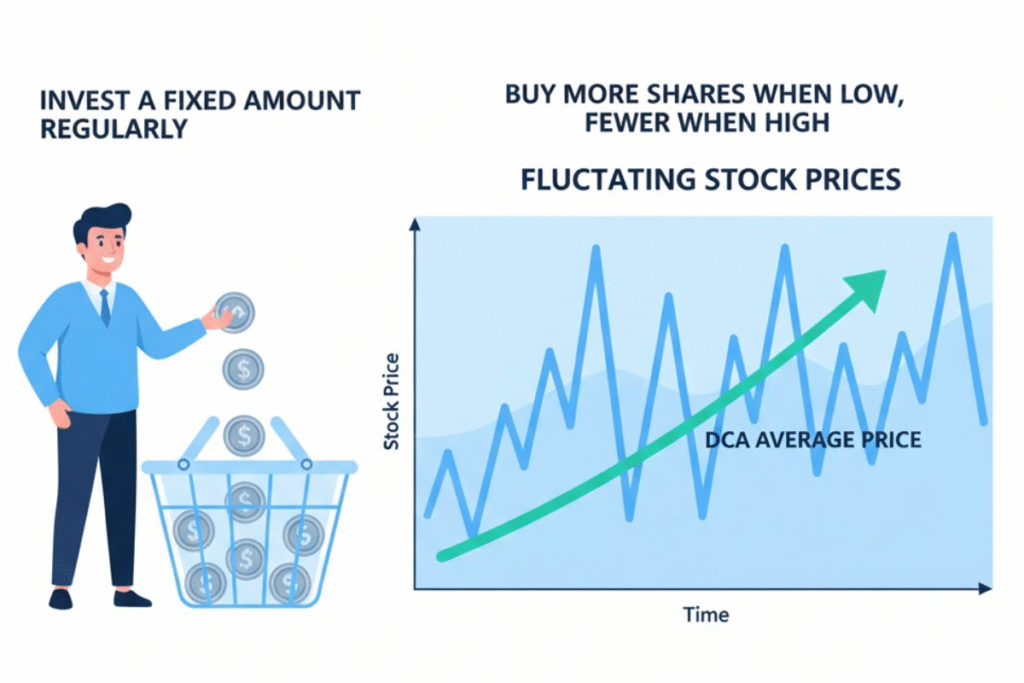
Also regular investing can ease the emotional pressure of trying to time a boom. One nuance, dollar cost averaging strategy is mostly a behavioral tool when you have a lump sum to begin with. Vanguard’s research, both historical and simulated, found that investing a lump sum right away beat a short cost-averaging strategy about two-thirds of the time, because markets tend to appreciate over time. But for the very loss-averse investor, slow investing can still help to stay committed instead of freezing in cash16.
The recovery math every investor should know
A deep loss hurts twice first you lose capital, then you need a larger percentage gain on the smaller base to get back to even.
Losses are not symmetrical with recoveries
Pure arithmetic: required gain = loss ÷ (1 − loss).
−10%
needs +11.1%
−20%
needs +25%
−33%
needs +49.3%
−50%
needs +100%
−78%
needs +354.5%
This is not a market forecast. It explains why position sizing and avoiding forced sales matter.
Investment ideas to research — not a “buy list”
For readers seeking some exposure to the AI theme, the most useful distinction is not merely “AI stock versus non-AI stock.” Think in terms of layers of the value chain. Ask yourself what has to go right for each layer to earn an attractive return. If you’re ready to start comparing specific companies after reading through these risks, our guide to AI stocks to watch in 2026 is a good next step.
| AI layer | What supports the thesis | Main risk to research |
| Semiconductors & equipment | Explosive compute demand; strong current revenue evidence. | Cyclicality, customer concentration, export rules, slower incremental growth. |
| Hyperscale cloud | Existing customers, diversified profits, large contracted backlogs. | Capex intensity, depreciation, price competition, return on invested capital. |
| Data centers & power | AI requires physical capacity, electricity, cooling and grid upgrades. | Debt costs, permitting, utilization assumptions, customer credit quality. |
| Frontier AI labs | Very fast reported revenue growth and enterprise adoption. | Private-company disclosure, cash burn, model commoditization, repeated fundraising. |
| AI software adopters | Potential productivity gains without owning the most capital-intensive infrastructure. | Whether AI produces measurable margins or only higher software/compute costs. |
| Diversifiers | Broad-market, international and fixed-income exposure can reduce single-theme dependence. | May lag when megacap AI stocks lead; diversification does not eliminate market risk. |
An interesting research question for any AI investment is “Who pays whom and which balance sheet bears the risk if the growth slows?” A cloud company could pay a chip vendor. A cloud company could build for an AI lab. An AI lab could still rely on future fundraising. The biggest revenue number in the chain doesn’t necessarily give you the full picture of where the financial risk ultimately resides.
That same macro backdrop also affects purchasing power and benefit adjustments for retirees and income-focused households. Bottom line. Our explainer of the 2026 Social Security COLA increase provides useful context on how inflation gets transmitted to household income.
Bottom line: follow cash conversion, not hype
There is incredible real-world demand for the AI economy. Nvidia, AWS, and Google Cloud are not hypothetical companies, At the same time, the infrastructure race is consuming hundreds of billions of dollars, debt is playing a larger role in the funding mix, and the cost of capital has risen sharply.
That combination is a more useful investor question than “bubble or not?” Question whether each layer of the AI ecosystem is shifting from consuming capital to generating cash. If revenue continues to compound, utilization goes up, financing spreads steady and free cash flow recovers, the boom could mature rather than break. If funding costs go up and cash conversion stalls, technology can keep winning while investors lose.
- Livemint.com : https://www.livemint.com/global/how-to-know-when-the-ai-boom-is-about-to-go-bust-11790513721264.html ↩︎
- Reuters.com : https://www.reuters.com/business/retail-consumer/amazon-beats-estimates-quarterly-cloud-revenue-growth-2026-07-30/ ↩︎
- Sec.gov : https://www.sec.gov/Archives/edgar/data/1652044/000165204426000066/googexhibit991q22026.htm ↩︎
- Nvidia.com : https://investor.nvidia.com/news/press-release-details/2026/NVIDIA-Announces-Financial-Results-for-Second-Quarter-Fiscal-2027/ ↩︎
- Aboutamazon.com : https://ir.aboutamazon.com/news-release/news-release-details/2026/Amazon-com-Announces-Second-Quarter-Results/default.aspx ↩︎
- Sec.goc : https://www.sec.gov/Archives/edgar/data/1652044/000165204426000066/googexhibit991q22026.htm ↩︎
- Investing.com : https://www.investing.com/news/stock-market-news/anthropic-revenue-run-rate-tops-65-billion-source-says-4864031 ↩︎
- Reuters.com : https://www.reuters.com/legal/transactional/openai-mulls-funding-round-12-trillion-valuation-ahead-ipo-ft-reports-2026-09-15/ ↩︎
- Ft.com : https://www.ft.com/content/6011d061-eee3-4193-b3b7-8ee4155f538c ↩︎
- Theinformation.com : https://www.theinformation.com/briefings/openai-said-forecast-nearly-280-billion-cash-burn-end-2030 ↩︎
- Factset.com : https://insight.factset.com/hyperscalers-tap-external-financing-as-ai-capex-outruns-cash-flow ↩︎
- Reuters.com : https://www.reuters.com/legal/transactional/corporate-bond-buyers-get-picky-with-flood-ai-debt-2026-09-22/ ↩︎
- Advisorperspectives.com : https://www.advisorperspectives.com/dshort/updates/2026/09/25/treasury-yields-snapshot-september-25-2026 ↩︎
- Atlantisdatasolutions.com : https://atlantisdatasolutions.com/bond/US68389XEB73 ↩︎
- Spglobal.com : https://www.spglobal.com/spdji/en/indices/equity/sp-500/ ↩︎
- Vanguard.com : https://corporate.vanguard.com/content/dam/corp/research/pdf/cost_averaging_invest_now_or_temporarily_hold_your_cash.pdf ↩︎