A second spike in borrowing costs has created a bizarre 2026 housing market where inflation is eating into home values, but buyers are footing a heftier monthly bill. The same pace of rate change applies to bonds, savings and stock portfolios.
Imagine a house that barely changes in price. You might think it will be easier to buy next year. But your mortgage payment can rise if the mortgage rate increases between now and when you get the keys even if the house is cheaper after taking inflation into account. That’s the fundamental contradiction in this rate shock – and it’s more useful to your decision-making than a prediction about whether house prices will “crash.”
7.03%
30-year mortgage rate·
Sept 24
+$178
Monthly payment on a $400k loan vs
June 18
−1.9%
June home-price change after inflation, approx.
On September 16 the Fed raised its policy target to 3.75–4.00%. The 30-year fixed mortgage rate soared to 7.03% in Freddie Mac’s survey on Sept. 24, compared with 6.36% on June 18. The 10-year Treasury par yield was 5.17% as of Sept. 25. There are three rates, each set separately. The Fed sets the overnight target rate. Treasury investors set long bond yields. Lenders set mortgage rates based on long term funding costs, credit risk, servicing and other spreads. They move together a lot but there’s no one-to-one rule 1234.
The payment moved faster than the price
The principal and interest payment for a $400,000, 30 year fixed loan at the survey rate of 6.36% on June 18 would be about $2,492 a month. At 7.03% on September 24, it would be about $2,669 — roughly $178 more each month, or about $2,133 more over 12 months, assuming the loan is newly originated at each rate. This is a calculation and not a mortgage quote23.
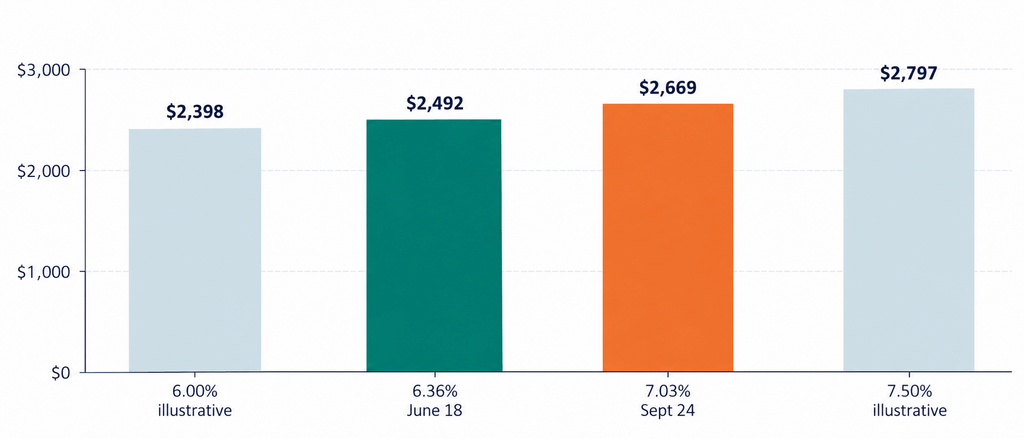
A $400,000 loan becomes harder to carry. Monthly principal and interest over 30 years. June 18 and September 24 rates are observed Freddie Mac weekly averages; 6.00% and 7.50% are illustrative sensitivity points. Taxes, insurance, fees and mortgage insurance are excluded.
Here’s a more subtle version of that math. Let’s say the house costs $500k, and you put 20% down, so you borrow $400k. With a 20% down payment, a mortgage rate increase from 6.36% to 7.03% would require about a 6.7% ($466,700) drop in house prices to keep the principal-and-interest payment roughly the same. Changing the illustrative 6.00% to 7.03% will require about a 10.2% price reduction at the same terms.
Break-even price ratio = monthly payment factor at the old rate ÷ monthly payment factor at the new rate
The calculation scales both the price and loan by the same percentage. A smaller cash down payment at a lower purchase price is another effect; property tax, insurance, HOA charges, transaction costs and loan eligibility can change the full picture.
So are U.S. homes actually getting cheaper?
“Yes, in a sense. The most recent Case-Shiller national index available at the time of writing is for June 2026 and it was up 1.5% from June 2025. The consumer inflation rate for June was 3.5%, so the home value adjusted for inflation fell by about 1.9% (1.015 ÷ 1.035 − 1). S&P has seen 13 straight months of negative real annual home-price growth through June. That is a drop in purchasing-power value, not a nominal dollar asking price drop of 1.9%7.
There’s also a useful check on certainty. FHFA’s separate house price index showed 2.1% annual appreciation in Q2 2026. But the two measures are dealing with different pools and different methodologies, so one national number should not decide whether a home is fairly or unfairly priced8.
And “the U.S. market” is many markets. Chicago was up 6.9% year over year in June, while Seattle was down 2.0%. National averages can obscure the particular city and neighborhood that a buyer has to settle for7.
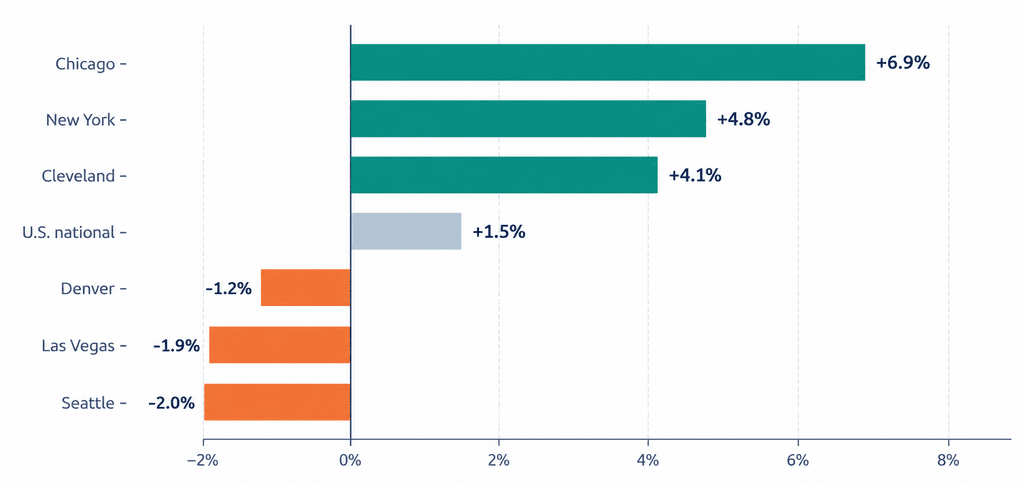
The national average conceals a wide split. Case Shiller nominal YoY home price changes, June 2026. Selected metros shown for contrast; national figure is not a metro. Detroit’s June reading was unavailable owing to transaction recording delays.
Why don’t higher prices make every seller lower prices? Many current owners have locked in rates on their mortgages. Selling can mean going from a cheap old loan to an expensive new one. This “rate lock-in” phenomenon was documented in Freddie Mac research, which found that lower supply can support prices, even as higher monthly payments dampen demand10. We suspect that a slower market might first show up as fewer transactions, concessions and longer selling times before a dramatic nationwide headline decline.
The same shock reaches your portfolio
Housing is the most visible part of the story, but the long term discount rate is important elsewhere. When comparable new bonds pay higher yields, a bond bought when yields were lower loses market value. A simple approximation is price change ≈ -modified duration * change in yield. It describes a point sensitivity, not the return you will earn if you hold a bond to maturity. The SEC notes that interest-rate risk tends to be higher for longer maturity and lower coupon securities11.
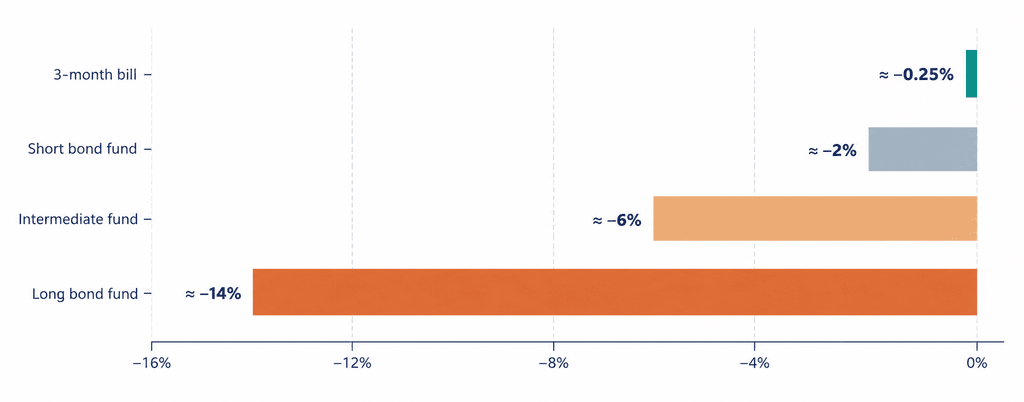
Illustrative impact of a 1 percentage point rise in yield. Assumed modified durations of 0.25, 2, 6 and 14 years, respectively. Approximate price changes only. These are hypothetical instruments, not measured 2026 fund returns. Coupon income, convexity, credit changes, fees and reinvestment are excluded.
| Your situation | What changes | Useful question |
| Buying within 1–3 years | Higher cash yields may help your down payment. Long bonds can lose value right when you need to sell. | Does the maturity of my savings match my purchase date? |
| Owning a long bond fund | Price may fall when yields rise. Future income can improve as holdings roll over. | What is the fund’s effective duration? |
| Holding growth or AI stocks | Higher discount rates can pressure valuations based on earnings far in the future. Company earnings and expectations also matter. | Am I buying business growth at a price I can justify? |
| Already on a low fixed mortgage | Your scheduled principal and interest payment is protected from a rate reset, though taxes and insurance may change. | Is selling worth giving up the old rate? |
The 3-month par yield on the Treasury was 4.24% on September 25 and the 10-year par yield was 5.17%. These are market benchmarks not guarantyd savings account rates or predictions for what rates will do next4. Short Treasury bills limit sensitivity to another rate hike if held to maturity but expose savers to reinvestment risk if yields subsequently fall. Treasury floating rate notes reset their index each week. TIPS adjust principal for inflation but a TIPS fund can still lose market value if real yields rise1314.
Higher yields are not necessarily a sell signal for equity investors but an urge to think about valuation and portfolio concentration. Homebuilders may be under pressure from affordability, but their share prices are also impacted by things like land cost, incentives, margins and expectations. REITs are very different depending on the type of property and debt structure. The original draft has omitted the single homebuilder ETF return and implied tight correlation with Treasury yields, as no reliable investing rule can be established through a short term comparison.
A practical decision framework
- If you plan to buy: compare several written Loan Estimates on the same day and inspect the full monthly payment, cash needed at closing, APR and five year cost. Stress test the payment without assuming you can refinance soon. The CFPB recommends examining the worst case rate for an adjustable rate mortgage.
- If you are waiting: track the actual local combination of sale prices, available homes, taxes, insurance and financing. A modest price concession may be outweighed by a higher mortgage rate. Keep a down payment in assets appropriate to the purchase horizon.
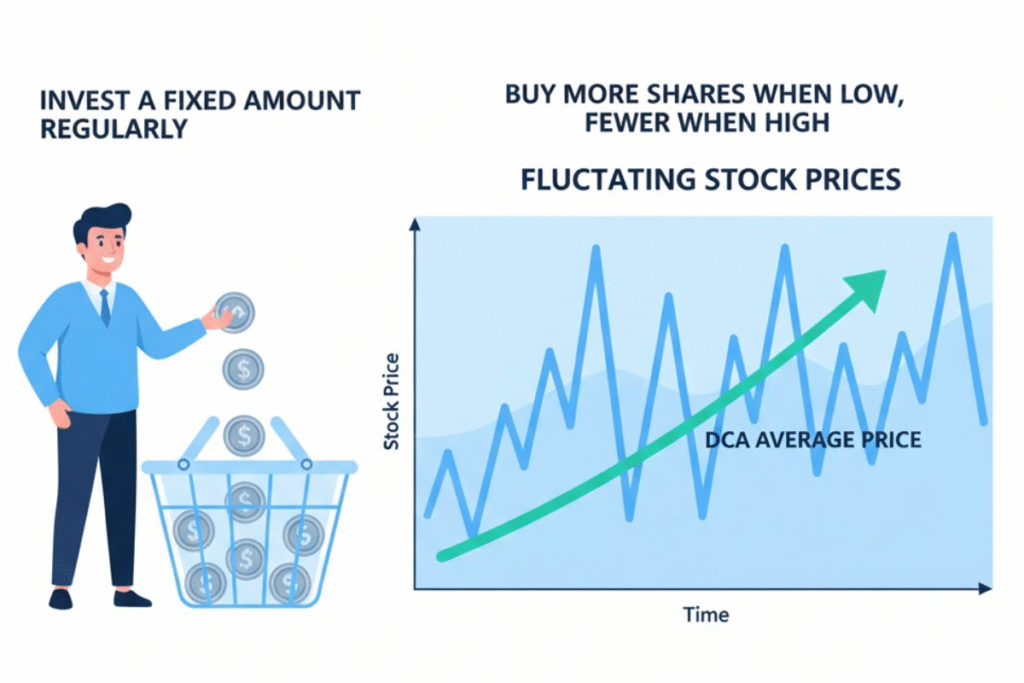
- If you invest: check bond duration and how much of your portfolio depends on lower future rates. A diversified stock allocation can still make sense. A recurring plan such as dollar cost averaging can reduce the need to guess the next Fed move.
- If you already own: treat the value of a low fixed rate mortgage as part of your household balance sheet. Separate the home you need to live in from the liquid investments you may need for other goals.
The signal to watch next
As of September 27, the newest Case Shiller national reading is for June, while the mortgage survey is from late September. Watch the next home price releases, local inventory and contract activity alongside mortgage rates. A future price cut could restore affordability. A future rate cut could do the same. Neither is guaranteed, and each market will adjust differently.
The 2026 rate shock is not a layup for one winner. Higher short-term income for prudent savers, penalties for some borrowers and long-duration assets and an inflation-adjusted housing correction that is less beneficial for buyers than the headline suggests. So the most useful question is not ‘Will house prices fall?’ It is “If rates don’t save me, what monthly payment, total cost and portfolio risk can I afford?”
- Federalreserve.gov : https://www.federalreserve.gov/newsevents/pressreleases/monetary20260916a.htm ↩︎
- Freddiemac.com : https://www.freddiemac.com/pmms ↩︎
- Freddiemac.com : https://www.freddiemac.com/pmms/archive ↩︎
- Treasury.gov : https://home.treasury.gov/resource-center/data-chart-center/interest-rates/TextView?field_tdr_date_value=2026&type=daily_treasury_yield_curve ↩︎
- Freddiemac.com : https://www.freddiemac.com/pmms ↩︎
- Freddiemac.com : https://www.freddiemac.com/pmms/archive ↩︎
- Spblobal.com : https://www.spglobal.com/spdji/en/index-announcements/article/sp-cotality-case-shiller-index-reports-annual-gain-in-june-2026/ ↩︎
- Fhfa.gov : https://www.fhfa.gov/news/news-release/u.s.-house-prices-rise-2.1-percent-year-over-year-up-0.3-percent-quarter-over-quarter ↩︎
- Spblobal.com : https://www.spglobal.com/spdji/en/index-announcements/article/sp-cotality-case-shiller-index-reports-annual-gain-in-june-2026/ ↩︎
- Freddiemac.com : https://www.freddiemac.com/research/insight/mortgage-rate-lock-in ↩︎
- Investor.gov : https://www.investor.gov/introduction-investing/general-resources/news-alerts/alerts-bulletins/investor-bulletins-86 ↩︎
- Treasury.gov : https://home.treasury.gov/resource-center/data-chart-center/interest-rates/TextView?field_tdr_date_value=2026&type=daily_treasury_yield_curve ↩︎
- Treasurydirect.gov : https://www.treasurydirect.gov/marketable-securities/floating-rate-notes/ ↩︎
- Treasurydirect.gov : https://www.treasurydirect.gov/marketable-securities/tips/ ↩︎